Friday, September 29, 2006

Makes Sense to Me

I really like that idea. I am very into organization and structure so that makes sense to me. Discipleship needs to start out with a good foundation of Christian basics. Just like at college, Freshman always begin with basic core courses and then add electives and advanced courses as they mature in their study. But, how do we use this focus on the book learning of discipleship (study of Christian principles and the Word) and mesh it with the life application, are you a living disciple and not just can recall the Bible and talk about it in a class?

Kimberly Lego

Terry Ewell said...

About 5 or 6 years ago Trinity had in place a curriculum of adult education. The analogy was made to baseball with the idea that a person would take 1 class in each of 4 categories and "run the bases." With changes of pastors overseeing the adult education this idea fell by the wayside.

Creating a tiered approach to education makes a lot of sense. Classes and curriculum could be tailored to the needs of the students.

The biggest problem, however, is with access. Not everyone can make a Wednesday evening or a Sunday morning, for example, so any sort of curriculum will need to have some flexibility built into it. I think that video taping classes, streaming videos, recorded teachings offer many possibilities for asynchronous (not at the same time) education. For instance, a person with a long commute could listen to a recorded teaching.

A multilayered, multidimensional approach may be the best way to help our congregation develop in their walk in Christ:

+1 to 1 discipleship
+small groups (supplied videos or teaching series)
+Sunday and Wednesday classes
+Online helps and links at the Trinity Web site
+Check out materials: CDs, tapes, DVDs, books
+Teaching and encouragement from the pulpit
+Seminars on campus

Terry

Tuesday Recap


Tuesday was awesome. Each member was engaged in passionate conversation about what a disciple is what a preferred discipleship future looked like for Trinity.
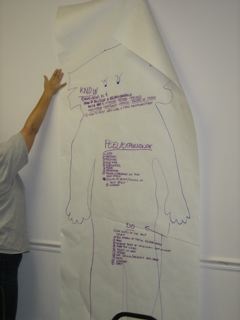
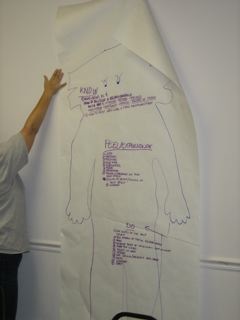
As a recap, we began the time by pairing off the members and having them draw an outline of one person on 8 ft. butcher paper. At the head, we were asked to reflect on our reading and blogging and come up with everything that a disciple of Jesus should know. At the heart, we were to write everything a disciple should feel. Finally, at the hands and feet, we were to write everything a disciple should do. This was fun for the team, but also very enlightening as each team made a presentation. Here are some of the results:
A disciple should know how to worship, how to study and apply God’s Word, salvation, God’s plan/purpose for them, repentance, forgiveness, love, acceptance, doctrine, other Christians, who Jesus is as savior, friend, deliverer, counselor, and the power of Jesus’ death and resurrection
A disciple should feel and experience God’s presence, connection to the body/sense of belonging, growth, healing, joy, love, acceptance, peace, passion, doing “right” things, and the power and presence of the Holy Spirit
The actions of a disciple are fellowship, prayer, witnessing, studying God’s word, giving, serving, reaching out to others, living like Jesus, selfless actions, good works.
Our long term goal is to develop a process whereby every person who attends Trinity will have the opportunity to continue to grow personally in Christ with the ultimate goal of serving the body in their giftedness and discipleing others. We will also have a plan for identifying, recruiting and developing new teachers. Our short term specific goal is that by January we will have clearly defined a discipleship path.
Serving Him,
Pastor Keith

Monday, September 25, 2006

Discipleship University

We have had a lot of great comments lately. I really appreciate your efforts. You are great. I hope you get a chance to read everyone's input.

Here is a question for you: What if discipleship at Trinity looked like a university - you know, core courses along with some electives? We could track everyone's progress. Afterwards there would be Master's level courses with hands on training for the next generation of leaders. Finally, we could have another layer for our top leaders in the church. This would assure us that everyone learns the core and stays involved in life-long learning.

Hey, it's a thought. Any comments?

Serving Him,
Pastor Keith

The Church as Field or Force - Bonnie

I have just finished some study time and am contemplating church of the field and church of the force. Historically, we have been a church of the field, not through an error on our part really, the growth of Trinity from 250 active members to 1,200 with varying needs of the people caused that to happen and so many of "us" had a concept of what church should be. To be a disciple - to love unconditionally - that is really what it takes to be a disciple - to love without "the I need to receive back" thought pattern. how do we achieve that - by self-examination where are we - age wise? pattern wise? and then by reading his word, meditating, and realizing that each day we need to die to self. Now, during the course of our own evaluation, then how do we move into the body with that thought pattern so that the members of the body minister.

Some will develop by example and then we need to be better communicators between the areas of ministry. Also, we want our children to be part of the body then the body should be part of the children's ministry at times - e.g. for example a children's front porch service in the sanctuary once in a while and just as it would be done in the children's church. One thing that struck home with me is that we often times are "too concerned" about things being just "so" and what would people think if we actually sang a children's song or did something " a little childish" - but perhaps we would be working as one body recognizing that we all are at different levels. Or the teenagers - not just sitting in a section on Sunday mornings but taking up the offering - greeting some people - seeing a 17 year old standing at a door with a 45 to 60 year old - all part of ministering -and so as part of discipleship, we minister the love of Jesus.Well, I am up to chapter six and will over the next several days finish the book.

Definition of a Disciple - Pastor Griz

A disciple is someone who believes in and follows/lives like - Jesus (we are talking a Christian context right?) in a personal relationship that aligns itself with the teachings of the Bible.Considering that 9 out of 10 young people (93 percent) consider themselves to be Christian by the age 13... Of those who say they are Christian, only 4 percent would say:*They have made an important personal commitment to Jesus Christ and believe they will have eternal life solely because they have confessed their sins and accepted Jesus Christ as their Savior*Affirm the accuracy of all biblical teachings*Have a personal responsibility to share their faith*Believe that they are unable to attain eternal salvation except through the grace of God through Jesus Christ’s death and resurrection*Believe in the nature of God as the creator and sustainer of all that exists*Believe in the existence of Satan (God’s enemy) is a real being*Taken from George Barna, Transforming children into Spiritual Champions, Regal Books Ventura, CA 2003 pp. 33-34I’d say if the majority of Trinity’s young people were discipled to believe like this we would have some kind of awesome church! Sending out missionaries, Pastors, Teachers, Evangelists etc....

Comments on Chapter 9 by Terry

Page 1. Several aspects of the “no cost, free gift” and “event theology” hit home with me. As I observe my life and those saints around me I notice that little emphasis is placed upon sacrifice, study, diligence, and work in the faith. Our Christian lives resemble a series of experiences rather than a pattern of growth. We speak of this great event or that thing that happened or this new system. “You should go hear speaker X, s/he will change your life.” “This X series is wonderful.” “You have to be a part of the X Crusade.” Rarely do I hear people speaking of growth in their lives through Bible study, prayer, disciplined sacrifices—ME INCLUDED.

Dietrich Bonhoeffer’s concept of “cheap grace” comes to mind as well. By “cheap grace” Bonhoeffer meant grace without contrition or repentance, grace without obligation, grace without discipleship. He fully understood that grace cannot be earned but it is freely received. However, Bonhoeffer points out that grace without commitment results in a weak and ineffective disciple. James puts it this way, “Faith without works is dead.” (James 2:20) That’s pretty blunt, especially for Americans. It is too easy to think “I give a little in the offering plate, attend church, and that’s just right for me.” What are the ways that God wants to lead us in our culture as disciples so that we are not conformed to the pattern of thinking in our world (Rom. 12:1-2)?

I was quite struck by Lee’s writings on selection for discipleship. Disciples self select and then disciples are chosen. To an extent we have these two selection processes at Trinity, but are we doing enough? Should we be changing what we do?

Both selection processes cost something. They will take a new commitment, more time, more expense, and giving up of something else.

Self Selection:

Do we have ample opportunities for people to self-select ways in which they will learn more about God and grow in their faith?

Are there opportunities for children, for young adults, for those who work during Trinity class times, for those who cannot get away from their homes due to illness, for busy parents, etc.

Selection by others:

Do we in place selection of disciples for further growth and ministry?

Who makes that selection and when or how are they made?

How are people chosen for ministry positions?

How are those in ministry positions aided in their spiritual growth?

Terry

Sunday, September 24, 2006

From Angela

Pastor Keith,

I really enjoyed our session tonight. And, I like the path we are heading down. I like to see immediate goals, short-term goals, long-term goals and the ultimate goal. As I mentioned at the end of the session , I strongly believe the quadrants will overlap, work hand-in-hand and, in some cases, be dependant on one another. For example, we can create and develop a discipline and/or curriculum, but one's spiritual life must be "healthy" and ready to produce. I think it would do me a world of good to know what the spiritual life quadrant is doing to promote healthy spiritual life. I need to see the big picture and I need to see how things relate. Our output will only be enhanced by the cooperative efforts of other quadrants. It is more important for me to SEE what is being done than just to KNOW that it is being done.

I also feel strongly about having a plan of action. I would love for us to get to a place where we can evaluate our current discipleship programs/methods. If we look at what we do now, it should help guide us in the direction we need to go. Is there anything that Dr. Lee has created that we could use to evaluate what we currently offer? Does he have anything that shows what a healthy discipleship plan should include? In order to complete an evaluation, we would need something to compare it to. What is the "model" discipleship program? Small groups seem to be flourishing right now. However, I sometimes wonder what the parameters/requirements are for someone who would like to lead a small group. Are there any parameters/requirements? I love that we have a ton of small groups, but are we going for quantity or quality? I know of someone who wanted to start a small group and was immediately granted permission to do so. Since this is a leadership role, what do we do to ensure that what is being taught is what we want to be taught? Do we ever audit the person leading the group? I know for Children's Ministries, background checks are completed, we are asked if we were abused as children, etc. I realize this is for the protection of our children because it is obvious that we do not want a predator working in Children's Ministries. However, do we conduct any time of checks on those leading small groups? I think it is equally important to know the leader is in a healthy condition whether they are leading a child or an adult.

Also, in thinking about creating a discipleship "unit" (e.g., curriculum, plan of action, etc.) at Trinity....is there something that already exists that we can use as a model and customize it for Trinity? Would that help us get to point "B" quicker? How do we know that what we produce will be a comprehensive and complete work? Will we be having it audited and/or compared to something that already exists or by an expert in the field?

I think we have several obstacles to overcome when dealing with discipleship. Taking a look at what exists, creating/structuring/establishing/filling in the holes....whatever terminology is appropriate.....to facilitate the end product of a discipleship "unit" that is functional and effective for Trinity. Then, we need to have the resources in place that get the word out and let folks know what we have to offer. So, basically, we need to (1) figure out what needs to be done, (2) do it, and then (3) tell folks what we can do. I noticed the group tonight has a lack of confidence and assurance in our current offerings. In part, it seemed it was because they'd experienced themselves. Also, perhaps because they don't know what is even available. Communicating what we have to offer is a battle all in itself and it certainly is a never-ending task.

God bless,
Angela Le

Tuesday, September 05, 2006

What does Discipleship Look Like?

Hey Team,
What a great day we had! The picnic was great. The food was great. The fellowship was great. The weather was great. And best of all, we were able to meet great new friends. (However, I could have done without loosing the pastor's volleyball tornament. I think it was fixed.)

Anyway, thanks to all who made the day special. I can see why "Doing Life Together" is more than a slogan, it is a mantra.

Well, most of the people I talk to ask me what it is I am going to be doing at Trinity. When I mention the aspect of discipleship, it seems there is a big agreement that there needs to be a more focused effort in this area. Although our team has a responsibility to examine discipleship and ministries, I think it would be prudent for us to focus on one area at a time.

So... here are two questions to ask ourselves:
1. What is a disciple? I mean a true disciple. In other words, what is our goal?
2. If Trinity was known best for its discipleship, what would that look like? What would we be doing?

It would be great to hear your thoughts on this. Let's dream together.

Have a great Labor Day (don't work to hard),
Pastor Keith

Friday, September 01, 2006

Love, Acceptance, and Forgiveness

I was struck by the notion that Jerry and his crew really loved people. REALLY loved them.... In spite of the cost to themselves.

I happened to be in Rom 12 the day I read chapter one and was struck by the verse in the NTL that reads...Rom. 12:9 (NLT) Don’t just pretend that you love others. Really love them. Hate what is wrong. Stand on the side of the good. 10 Love each other with genuine affection, and take delight in honoring each other. 11 Never be lazy in your work, but serve the Lord enthusiastically.

I’ve asked myself do I really love people? Especially the unlovely ones... What if Trinity learned to love, really love all people, we would explode!!! It’s been a great thought.

Pastor Griz

Love, Acceptance, and Forgiveness

Dear Vision Team,

I just finished the first two chapters of Love, Acceptance, and Forgiveness. There are some wonderful statements Jerry makes that I think we can reflect on. This is not homework, but if you would like to respond to any of these feel free to do so:

1. “We began to understand that the church was people – real people – changed by the power of Christ…” (pg. 8). What was your understanding of church before you came to Christ? How about five years ago? What about now?

2. “The church is in the world to minister salvation to people” (11). Think about our prayer time using Isaiah 61. This is a prophetic word about the Messiah – Jesus. How do we connect what the church should be to Jesus?

3. “Every time you find a corresponding action to the concept of agape, it is a giving action” (13). We say we love the people of Baltimore, but what should our corresponding action look like compared with what our corresponding action is currently? Are there gaps?

4. After reading chapter two, what is the prophetic voice of Trinity trying to say to our surrounding areas? Why do we exist? If Trinity would go away tomorrow, what would the community miss?

Have a great week,
Pastor Keith

Q3 Team

My New Friends,

It was great to be with you tonight. It is late at night but I wanted to thank each of you for joining me on this new journey. I can't help but think of all of the possibilities and potential within the room. It is so great to be with people that are passionate about helping people find a pathway for spiritual development. I have traveled to many churches and I know the ones that are growing are the ones that are taking discipleship seriously.

Julie's comments really speak to us about the need for us to do well. We must not fail in discipleship. Jesus said to go into all the world and make disciples, not simply converts. This has to be intentional and strategic.

And this is only one small piece of our work ahead of us, but if we work together, pray together, and do life together, God is going to give us great joy for the journey.

A reminder:
1. We are praying 15 minutes before each of the morning services - try to attend one of them.
2. Sit in the front third of the sanctuary on Sundays.
3. Read the book, "Love, Acceptance, and Forgiveness" by Jerry Cook and Stanley Baldwin.
3. Prepare your heart for personal renewal and transformation.
4. Be prepared for thinking big and outside the box.
5. Pray for God's direction and vision
6. Be my friend at the picnic!!!!!!!!!!!

Let's keep this dialogue open. Send your comments to revkeithedwards@aol.com and I will post this for the whole team to read.

May you hear God's voice in all of this.

Serving Him,
Pastor Keith